


📹 Unfound Peoples Videotechnic | Cloud-based filmmaking thought. ☁️
🦋 Bluesky | ⏰ TikTok | 📸 Instagram | 😐 Facebook | 🎞️ Letterboxd | 🌐 unfound.video
Dear eternal filmmaking students,
It’s been a tough year in cinema for hapless white blokes and Alana Haim characters. I’m not Alana Haim, but I also struggled: my efforts to create a trend - 𝕦𝕟𝕜𝕖𝕞𝕡𝕥 𝕓𝕠𝕪 𝕒𝕦𝕥𝕦𝕞𝕟 - based on the wrinkled vintage M&S-core shirts and sloppy beardsmanship of Josh O’Conner, Wagner Moura et al. (et me) failed to go viral.


The sun has had a better year, snatching small but pivotal roles in Levers, Resurrection, Nosferatu and more.
I didn’t see many “new movies” in 2025. But that didn’t stop me from submitting a “top 10 movies of 2025” list for a poll held by the email community. The results were announced live on computers last night, and - I’m writing this before hearing the results - I lost massively.
You can read that list elsewhere; here, I have summed up, Axios-style and in no special order, my notes on some of the most and least important movies of 2025. Let’s all try again next year.
Some movies of 2025 (Director names in brackets)
Sirāt (Óliver Laxe)
Genre: It’s Gerry meets The Wages of Fear - on acid-laced poo!
In a nutshell: Quentin Dupieux picture without the jokes. A suburban dad and his son join a band of techno minstrels on an odyssey across the Moroccan desert, but they get into a bit of a pickle. The irony of the floor-is-lava climax scene is that you know these characters must have spent a considerable amount of time tightrope-walking in parks.
Why it matters: Just when you think the dialogue has hit a low point, it turns out to be an incantation that unlocks another metaphysical realm. Brilliant!
Lesson for filmmakers: Not sure any of the actors or non-actors managed to “go there” with their grief. But also: how to do this? Laxe comes closest to articulating grief when Sirāt shifts from desert realism to broader visual metaphor and/or batshittery.
On a personal note: Would’ve been funnier if the movie’s wandering desert ravers had encountered the Daft Punk robots walking back the other way.
Go deeper: Don’t let your characters get lost like the ravers of Sirāt. Instead, try baking a map right into your movie. Read more:

The Mastermind (Kelly Reichardt)
Genre: Low-octane crime dribbler (the corduroy Good Time).
In a nutshell: It’s Kelly Reichardt’s turn with the heist drums. She ropes in 2025-veteran Josh O’Connor for one last job as a compulsive thief and dreamy granny-basher. But honestly, nobody seems very motivated in this movie. JoCo’s anti-hero doesn’t desperately need the money. No one points a gun at him. And when he’s on the run, he turns down a chance to hop the border because he doesn’t fancy Canada. (The scene of him forging a passport exists only for the practical challenge and sensual pleasure - it’s a shame JB will be in prison when Antonioni’s The Passenger hits the cinemas in 1975).
Why it matters: John Magaro’s smile.
Lesson for filmmakers: The great thing about making a getaway film is that you can end it when you get bored, and The Mastermind’s abrupt ending manages both an actual surprise (the second of the movie) and thematic resonance. The most thrilling (and relatable) scene, however, is when Josh tries to put something in the loft.
On a personal note: Perhaps this is like when dogs ask for more dog content, but I felt The Mastermind was just a shaving cut away from being one of the great ‘Dad’ movies.
Go deeper: Cinematographer looking for an alternative to The Mastermind’s tea-stained patina? Try this:

Bonus tip: The most practical Kelly Reichardt interview I came across for this movie was in Vogue, actually.
Resurrection (Bi Gan)
Genre: Megalopolis but competent.
In a nutshell: In a future where filmmakers have forgotten how to dream, Bi Gan succumbs to “young filmmaker with high expectations on his shoulder” syndrome and is condemned to wander an over-elaborate 20th-century film set forever with his long-suffering camera operator.
Why it matters: Nobody in narrative cinema understands the power and potential of the image volume - “the pretend space beyond the surface of a movie’s image” - like Bi Gan.
Lesson for filmmakers: Make sure you charge the batteries when you get your camera back from Bi.
On a personal note: It turns out the three edge seats on the Regent Street Cinema seating plan are weird little balconies that give an oblique, slightly obstructed view and an evening of shared intimacy with a dating couple sitting next to you.
Go deeper: How filmmakers can build a little pretend-volumetric universe from scratch:

Materialists (Celine Song)
Genre: People talk about “foreign cinema,” but I have rarely had such a profound feeling of experiencing an exotic culture conveyed through an exotic screen language.
In a nutshell: Kerry from Succession seeks an equally rich but slightly taller replacement for Logan Roy. Unfortunately, she hires the world’s most cynical and over-screenwriting-workshopped matchmaker (Dakota Johnson) whose Main Character Genes have a better chance than Kerry of surviving natural selection and taking a decent inheritance along down the generations.
Why it matters: Apparently, the man playing “John” is one of the world’s highest-grossing actors, although I’ve never seen him before.
Lesson for filmmakers: Celine Song is a very thorough screenwriter: the dialogue is all written in triplicate so that nothing gets missed.
On a personal note: I started watching this for reasons I’m not prepared to get into. I wished the characters all good luck around the 45-minute mark and went to bed.
Go deeper: If you, like the Materialists, seek money and aren’t sure why nobody’s given you any to make your feature, read this:

One Battle After Another (Paul Thomas Anderson)
Genre: Tunnel fiction.
In a nutshell: It’s literally one battle after a bloody nother.
Why it matters: Sarcastically puts Eddington’s equivocality into perspective. In Eddington’s world, evil doesn’t exist, but everyone is equally spiteful; in OBAA’s, half the characters are evil, and half are noble (and mostly either incompetent, drunk, or dead). As such, between the two films, there’s something for all audiences.
Lesson for filmmakers: In a year of movies titled after character names (Hamnet, Jay Kelly, Nosferatu, Steve), character traits (Deaf, Left-Handed Girl, The Running Man), or character pillow talk (Honey Don’t!, Sorry, Baby, Wake Up Dead Man), fair play to PTA for naming this one after his plot structure.
On a personal note: Thank you, Lockwood, for taking me to see this for my birthday ☺️.
Go deeper: Inspired by PTA’s use of space and spaces? Read ↓this↓ before you make your next picture!

Black Bag (Steven Soderbergh)
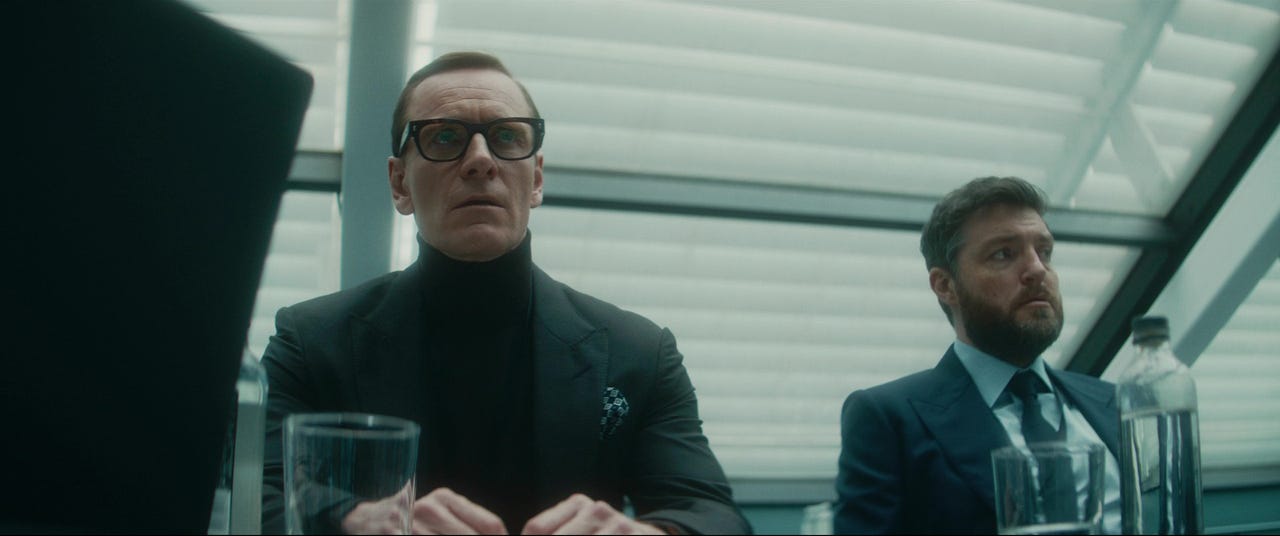
Genre: A whodunit wrapped in a marriage wrapped in a national spy agency wrapped in an extensive and versatile director filmography.
In a nutshell: The real puzzle is to work out who Fassbender’s performance is an impersonation of. There are five suspects and one of them is his wife.
Why it matters: A glance at the quotes page on IMDb will show you how bad the dialogue is, but Marisa Abela’s “cover to cover” is this movie’s “a few small beers” and Abela/Del Toro are 2025’s Cheekiest Characters®.
Lesson for filmmakers: Tom Burke expertly exceeds his allotted space as a British TV actor - i.e. he doesn’t seem like one - without exceeding his allotted space as a British character - i.e., his horizons are foreshortened.
On a personal note: I’m curious if the “Dark Windows” movie the heroes go to see is the real Dark Windows (2023), but I’m not prepared to watch the real Dark Windows (2023) to find out.
Go deeper: Planning a “game with guns” sequence like Soderbergh’s climactic scene? Nobody’s done it better than Hollis & Joyce:

The Choral (Nicholas Hytner)
Genre: British
In a nutshell: Untitled Alan Bennet Movie, Great War Edition
Why it matters: Maybe the UK’s “Materialists.”
Lesson for filmmakers: The Choral’s dialogue is all spoken very slowly, and most of the choir are there to explain the ‘plot’ to each other and, by extension, older and/or TV audiences. You could consider making a version of your movie this way, just as European filmmakers used to shoot their scenes in French and then re-shoot them in German to make parallel versions for different audiences.
Bonus lesson: I don’t know much about lenses - but I’m pretty sure they were using the wrong lenses for much of this movie.
On a personal note: I went to see it with my mum, which is the proper use of this film. An unexpected handjob gag towards the end of the second act ruined the mood.1
Go deeper: What we exposit about when we exposit about exposition:

The 8th of April, 2024 (Patrick Marshall)
Genre: Home movie, road movie, home road movie, eclipse movie
In a nutshell: Multiple filmmakers this year have experimented with triangulating movie time, auditorium time, and the movement of the sun. This movie is both the cutest and the most political of them.
Why it matters: It's showing at the London Short Film Festival in January.
Lesson for filmmakers: You can pack it all into the length of a single Super 8 cartridge.
On a personal note: Patrick is one of my best friends, but I would love this movie anyway.
Go deeper: How the home moviemaker might match her structure to her theme:

Levers (Rhayne Vermette)
Genre: Eclipse movie
In a nutshell: It’s a “John Cage cover version of Chris Kraus’s Gravity and Grace.” On serotonin!”
Why it matters: Rhayne Vermette gets her silly on! Rarely has a ‘serious piece of filmmaking’ been so playful.
Lesson for filmmakers: “filmmaking is such a potent ground to actually manifest some shit.”
On a personal note: My favourite new movie of the year… and the one that truly got my “I love cinema” senses tingling.
Go deeper: How to make a movie without showing anything:

The Phoenician Scheme (Wes Anderson)
Genre: Wes Anderson
In a nutshell: Benicio del Toro, Mia Threapleton, Michael Cera, Riz Ahmed, Tom Hanks, Bryan Cranston, Mathieu Amalric, Richard Ayoade, Jeffrey Wright, Scarlett Johansson, Benedict Cumberbatch, Rupert Friend, Hope Davis, F. Murray Abraham, Charlotte Gainsbourg, Willem Dafoe, and Bill Murray.
Why it matters: The real-world battle for freedom in America is being fought through egregious manipulation of the paper theatre of public life, from the built environment back through a palimpsest of politically revisioned online media, engineered language use and a backdrop of AI-driven illusionism and manufactured consent, and here we are hate-fucking the latest Wes Anderson picture with our eyes 👍.
Lesson for filmmakers: Spend 15 years studying the movies of Karel Zeman and then the rest of your life trying to forget them.
On a personal note: I don’t remember watching this movie, but I can imagine what I saw.
Go deeper: On building your movie with cardboard:

So that’s where we are in cinema. We all hate each other and we’re going insane. America is tying off the human project, even if elsewhere we’ve still got a lot on. Okay! Fine.
Going forward, we’ll be checking in on Timothee Chalamet’s pursuit of greatness, making sure he’s touching all the progress markers and milestones. While being careful not to veer from our own path towards mediocrity. Along with my job application to knot Josh O’Connor’s ties for him, this may mean there won’t be any UPV emails for a while. Well, there are lots of old ones to read.
See you in 2026 - at the movies, no doubt!
~Graeme Cole.
(Principal)

Perhaps I should clarify, it wasn’t my mum that made the handjob gag, it was part of the movie.
“So that’s where we are in cinema. We all hate each other and we’re going insane.”
It does feel a little frayed, doesn’t it? Like everyone’s shouting over the same flickering screen.