


🦋 Bluesky | ⏰ TikTok | 📸 Instagram | 😐 Facebook | 🎞️ Letterboxd | 🌐unfound.video
Dear eternal filmmaking students,
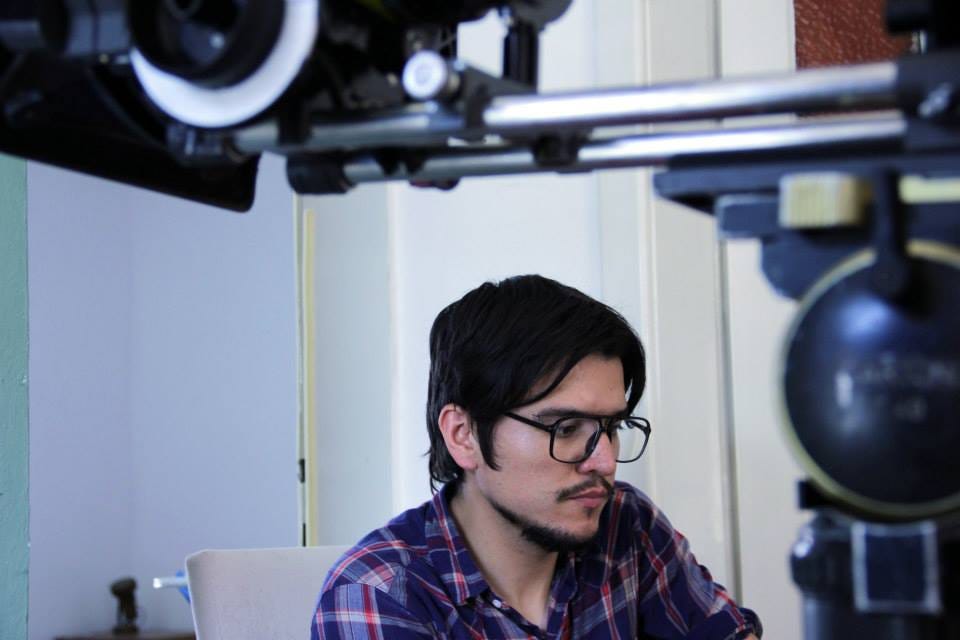
It is, by now, well-known film.factory lore: of Béla Tarr’s 10 first-generation graduating MFA students, four of us are now legally married to one or another of the others. And that includes Gonzalo Escobar Mora, the subject of Supply No.2, who is married to Emma Rozanski, who you read about in Supply No.1.1 They married in Vegas!
Bogotá- and sometimes Chicago-based Escobar Mora has a list of odd short fictions behind him. Not to mention his sophisticated short doc Accidentally Sprayed (2008).
Now he is preparing his first feature, “based on the true story of a mother, who, in order to continue with her life, defiantly requests a meeting with the young man who murdered her son.” It is called RETENTION. “Restorative justice, reality, and fiction come together in this hybrid film, where actors and the real characters of the story, come together to advance and expand the narrative,” he says.
And if you send him some funds before Sunday, it will help him meet his crowdfunding stretch goal and extend production to a two-week shoot!
In today’s lesson, Escobar Mora will discuss how:
🛒 Minimal resources inform his minimalist film language.
🧩 Sometimes you must retrieve the puzzle pieces of your film from parallel dimensions.
🪞 Popping in and out of his own film worlds helps the filmmaker to establish his perspective and show the viewer around.
🚦 Béla Tarr and Apichatpong Weerasethakul caused him to stop, look, and listen.
You may wish to watch the films before you read the interview (the links are below). You may want to watch them after! Settle down. Let’s meet your supply teacher.
Connecting the dots
I interviewed Gonzalo Escobar Mora by text message between the 20th and 30th April, 2026. Quotes have been lightly re-formatted. Escobar Mora says that’s okay.
There is a lot that seems elementary in the films of Gonzalo Escobar Mora.
The aesthetic seems raw. The camerawork, unfussy. The sound design, unadorned.
Seems that way, anyway!
Some of his films seem like found or selected moments from which the viewer can piece together a broader story and set of character arcs. Dialogue is sparse. Occasional sentences may colour a situation, but are of only supplementary use in following the connection between shots and sequences. Between “scenes.”
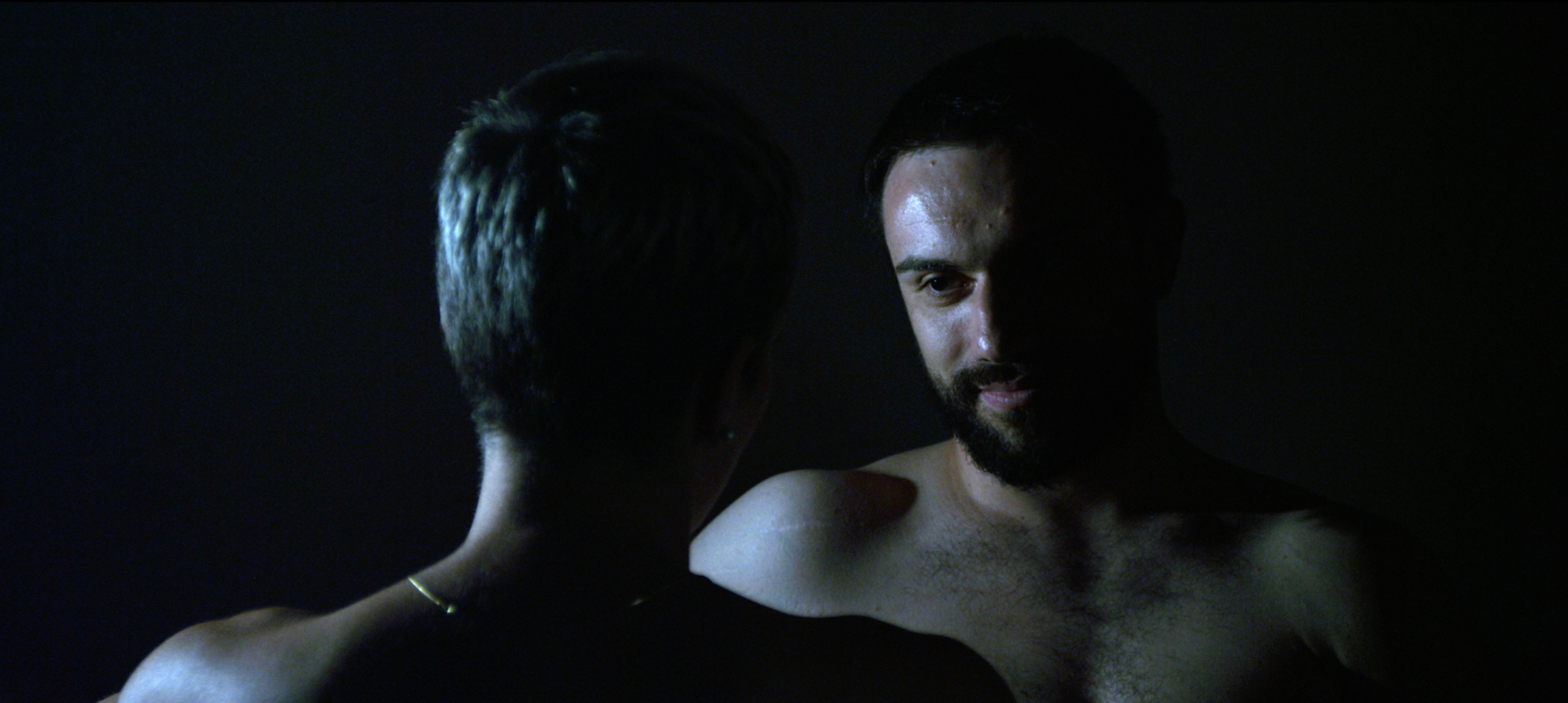
Escobar Mora’s first fiction was Amongst Us (2015). In it, a young couple separately deal with the feelings and infections that have arisen from their infidelities.
With its fixed frames, minimal in-frame action, and handsome cast, Amongst Us may feel like one of those angsty photo stories from old teenage magazines. But the motion picture adds a stillness that a photograph can’t contain.
“I would say that it is the result of an ‘instinctual style,’ mixed with consequences from the working conditions,” says Escobar Mora, on how he decides what to add or withhold from a set-up. “I think I am able to construct the ideas in my mind (which could be a regurgitating salad of the films I’ve seen and liked), but I have to admit that doing too many of the required jobs myself (camera, editing, sound mixing, colour correcting), has its positive and negative consequences in some of the films. Perhaps that is a style!” he says.
And indeed, from Amongst Us onwards, the relationship between the filmmaking conditions and the filmmaker’s style evolves. Minimal grading, chance locations, uncharismatic performances, and boxy sound come to delineate Escobar Mora’s captivating universe.
This universe awakens with a queasy sense of the uncanny but soon becomes outright weird. But normal-weird. Normal-weird, as a result of the thin line between:
the real-like raw elements that go into the film, and
their arrangement on and around the screen.
The strange ways his films think out his notions and curiosities at you emerge from how Escobar Mora “thinks” and “does” with his raw notions.
“The more you ‘chew on it’, contemplate it, around and around in your head, you start making sense of certain things, finding or adjusting connections,” he tells us. “It is not a very efficient process, but it is a way to solve my writing deficiencies.”
He made Pool Version (2016) in Sarajevo after Amongst Us.
“Pool Version was the result of wanting to make a film about a woman I met at a cafe, and finding at the same time an interesting location,” Escobar Mora tells us. “I was having issues choosing what to tell from her stories, so I ended up finding connections to the location scouting pictures. I basically wrote a script based on that, after staring at the images for a while, moving them around, and generating from them a kind of storyboard.”
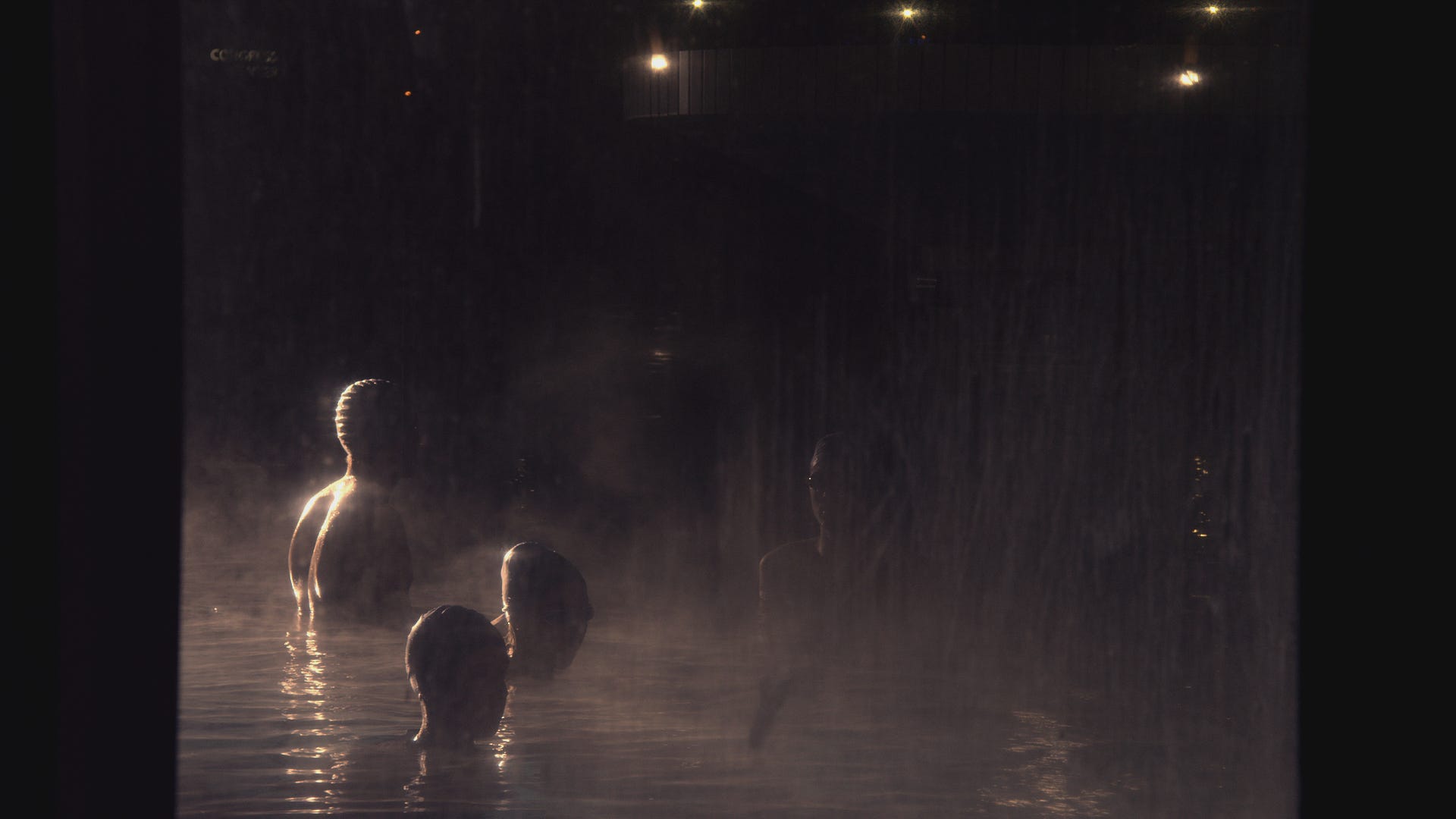
Pool Version extends Escobar Mora’s fragmentary style. The movie alternates between scenes of an unemployed woman’s encounters in a cafe and dreamlike sequences of a woman with the same face at a water park at night. The closest thing to a through line between the elements that make Pool Version is Alena Dzebo’s bare but compelling performance as an invisible woman, watched.
But she is also at the root of its split: switching between vape and cigarette as she nervously attempts to resell a hookah; different incarnations of the same neurosis shadow different layers of reality.
Matching silhouettes recur from one location and plain of reality to another. Apparently symbolic presences shapeshift or teleport through the sequences. Every bit part and non-player character seems to have a mythological purpose/presence. The elements are coming to life.
Beyond the apparent
The elementary nature of Gonzalo Escobar Mora’s movies situates them in a chaotic real-like world. A world where things be and happen much as they might in the cold chaos of your daily life. Narrative is in the eye of the beholder. “Narrative is in the eye of the beholder” means the filmmaker tasks the audience with resolving this world into sense.
But from Pool Version (2016) onwards, the filmmaker further complicates the relationship between the world in which he shoots his films and the world the audience encounters.
In Pool Version, non sequiturs, doppelgängers, and the director’s aesthetic choices confuse the apparent veracity of each shot. These oddities confuse the apparent veracity of each shot by undermining the movie’s initial real-like appearance.
But the filmmaker does offer clues. Clues on how the audience should evaluate the materials they encounter.
The title itself may be a clue on how to read the overlapping realities in the movie. Or it may just muddy the water.
In the opening shot, one of the filmmaker’s trademark long, observational takes, the perspective is thrown when a drinking glass is lifted to the ‘face’ of the camera.
Pool Version is “a film about itself.” The tagline says that. Escobar Mora tells us that he made this film about the process of making this film. The filmmaker character - played by Escobar Mora’s filmmaker colleague, Lorenzo Fabbro - is a fictionalised version of Escobar Mora.
In fact, Gonzalo Escobar Mora embeds himself in others of his films, too:
Accidentally Sprayed (2008) comes on like a political documentary but its politics are situated in the form of the personal essay.
In Enthusiasts (2021), Escobar Mora and his filmmaker wife, Emma Rozanski, play fictionalised versions of themselves.
Various of his films borrow the filmmaker’s biographical details.
“When the story is not about me, I have felt the need to include my personal connection, and make it part of the narrative,” Escobar Mora tells us. “It is like an ethical stance that helps in validating my intentions. I also usually enjoy being reminded of ‘the maker’ behind the work. I feel it gives a perspective on where to anchor your reactions.
“One very straight forward example (in the sense of actually seeing the maker) is Inextinguishable Fire by Harun Farocki; and another not so direct, The Headless Woman by Lucrecia Martel, where we feel the social class differences in the region where the filmmaker grew up, and where the movie takes place.
“I feel her perspective very much, especially in the scene where the protagonist drives to buy a plant pot in the neighbourhood where the dead kid used to live. The camera inside the car creates a powerful and smart tension that subtly feeds the whole movie.”
Living locations
“I do work with ‘carefully’ planned scripts,” Gonzalo Escobar Mora tells us. “Apart from liking ‘to feel prepared,’ it’s just a necessity with the time limitations on the set. However, I am aware of the ‘rigidity’ this preparedness can carry, so I thrive to be open to suggestions coming from the crew, actors, or the situations themselves.”
Gonzalo Escobar Mora’s debut film was a documentary, Accidentally Sprayed (2008). Poetic and political, more than a documentary, the film is an essay (a trying). A personal essay about the aerial fumigation of coca crops in Colombia and, more broadly, everybody’s complicity in everything.
Accidentally Sprayed was filmed and photographed on a range of formats. It encompasses bits of:
found footage,
animation,
interview,
meta-documentary,
children’s show,
staged protest, and
materials borrowed and shared between friends and brothers.
In Accidentally Sprayed, Escobar Mora explicitly mediates and re-mediates the materials and situations he selects or constructs. This makes it feel more deliberate than his short fictions.
His short fictions, although cooked up from his mind, appear to take form through encounter and juxtaposition rather than heavy-handed mediation or conspicuous editorialising. Well, Accidentally Sprayed is also about the media. And about the relationship between words, rhetoric, and science, and the world of doing, feeling, and hurting.
In other words, the world he encounters in Accidentally Sprayed is one of pre-existing conditions and materials. The worlds he encounters in his fictions are yet to unfold. The raw materials are right in front of him, and he keeps them raw.
“I always shoot a ‘freeer’ version of what was planned,” he tells us. “[But] the hardest thing is to make fast (and good) decisions when things are not working out. […] I could also say that my goal is to have the ‘mental clarity and openness’ I assume from filmmakers such as Apichatpong [Weerasethakul]. His films and his class exercises embody the way I would like to function on a set: being calmly alert of your surroundings, letting them infiltrate whatever you think your ideas are.
“As I am currently casting for my next film, I have very much present Béla’s take on it, which is based on finding and working with people’s personalities, rather than people ‘acting’ your characters. I guess this works for certain kinds of films.”
This is not to say that Escobar Mora refuses to acknowledge the presence and power of artifice in his fictions.
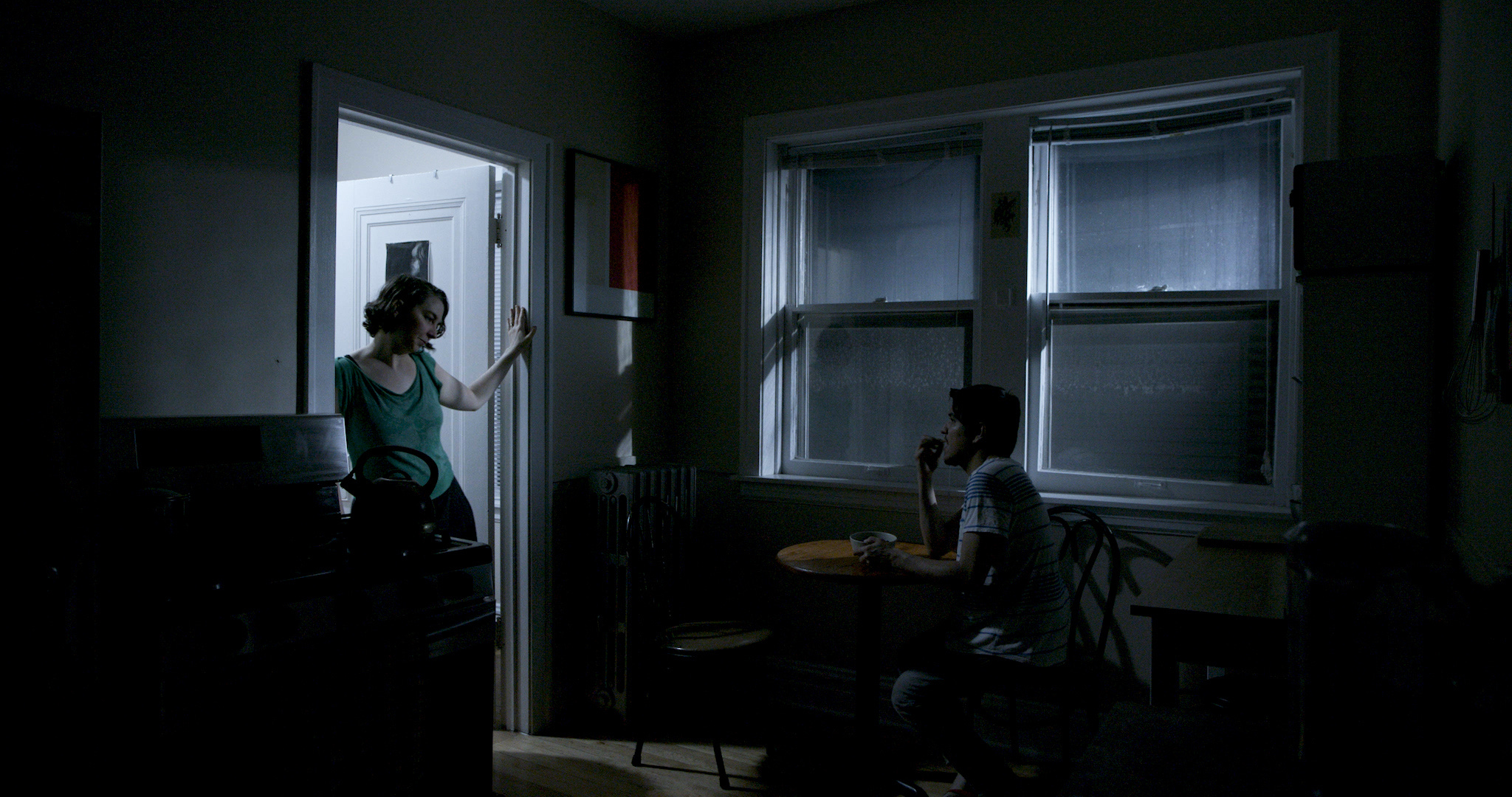
His trademark locked-off frames encourage the audience to find depth and meaning in framing, light play, and reflections. In Enthusiasts (2021), jumps through time are achieved with in-shot lighting effects and stylised sound design.
The viewer may even notice the characters ‘fade out’ in front of their background. Special effects! Their ghostly presences materialise the spectre of big life decisions and animate latent histories and/or futures of the filmmaker’s real-world flat.
A location is never just a background. Escobar Mora’s films acknowledge his complicity in the perpetual re-making of any given place. In doing so, he tenderises the tissue between the real world location and the spaces of his imagination.
“I am considering options for my next film. Depending on the budget, I might schedule rehearsals on the actual locations, have an editor on set, schedule longer shooting times, or aim simply to “listening to life” [sic], as our dear mentor [Béla Tarr] used to emphasise.”
Thank you, Gonzalo! We hope you get all the money you need.
Students, you can leave your thoughts, queries, and exercises from this week’s lesson in the comments.
School break
Unfound Peoples Videotechnic has inducted a few new subscribers since our last lesson in December. But I have been unable to press on with our usual Monday email-lessons. Today’s guest teacher spot is just a message out of the blue; I don’t know when you’ll hear from the school again.
I would love to teach you again soon. The amazing things I know. The fabulous things I imagine I know. But it just isn’t possible in the foreseeable. There isn’t the time. There isn’t the money. There isn’t the emotional strength!
But think of me when you’re eating your Monday morning pastries. I’ll be thinking of you.
And one last thing - share Gonzalo’s crowdfunder!
Class dismissed,
~Graeme Cole.
(Principal)
P.S. 🎶
If anybody else is married to any of these people, please let me know and I will interview you for Supply No.3.