


📹 Unfound Peoples Videotechnic | Cloud-based filmmaking thought. ☁️
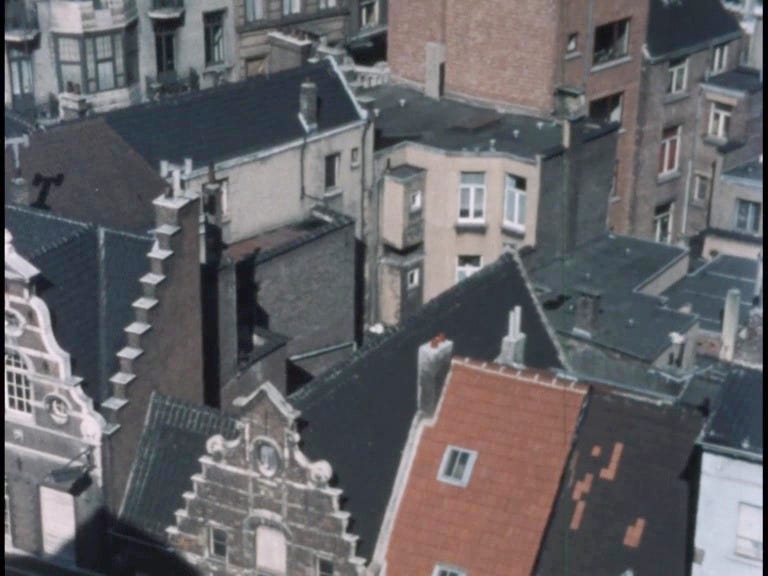
Dear eternal filmmaking students,
This is it: term coming to a premature close. You’ll find the final microessay of the series below.
I don’t know when the next will be. Could be quite a while. But that’s okay. As I’m sure you’ve understood by now, the gaps between the newsletters are as important as the newsletters themselves.
While I’m gone, I invite you to revisit our classes on beginnerism, image texture, and set design. And all the others! And I would be super-grateful if you could share the school’s texts with your colleagues, students, and professors. And all your little social media buddies.
Look, I can make some little buttons to guide you:
A new annotated contents page for last autumn’s series on home movies has also appeared:
And there’s the little button.
Great. Now. Remember last week’s essays on speculative Richard Linklaterism? We learned how:
“A metabolist epic is a movie that is filmed over a long period of time at intervals that more or less match the intervals in the narrative, so that the cast and environment age authentically.”
The danger in making such a film is that your cast or environment might change beyond usefulness before you reach the denouement.
One way to mitigate this risk is to build the volatility of nature and your actors into the premise of the movie.
Or you could go the other way and engage electronics, using powerful computer simulations or time travel to follow your actors into the future - though this comes with risks of its own.
Nice! I am sure we will all do that.
Missed a week? Joined late? Don’t worry about reading these lessons out of order. Each functions independently. They are sent in a sensible sequence but hardly reliant on it.
Now. Are you familiar with the sound of chairs scraping on the hard floor of a cold room on a Tuesday evening? Then I think you will totally get today’s lesson. It’s about the frozen time-outside-of-time of the extracurricular activity space, and how:
🎻 The opening of a film establishes its pitch and tension - just like an orchestral tune-up.
💭 But if the orchestral conductor or the filmmaker chooses to sustain that preparatory note forever, their work may leave linear time and form, instead, a bubble of time.
🎭 Belgian filmmaker Boris Lehman reinforced his film’s “bubble time” by nesting an absurdist bubble play within an absurdist documentary.
🎥 Lehman’s plot, prop, setting, music, framing, and editing choices all contribute to the pleasant, if disconcerting, non-time of his movie.
Maybe you’ve seen the movie we’re discussing: Ne pas stagner (Don’t Stagnate, Director: Boris Lehman, 1973). Maybe you’ll make an effort to watch it before or after reading. It doesn’t matter! There are no spoilers, because events in the movie just “are.”
Bubble time
You can hear me deliver this lesson by scrolling up to the header and clicking Listen and/or the play ▸ button.
During an orchestral tune-up, musicians and audience hover outside of time. The game has not yet begun, but neither can the players turn back. So, the concert conductor has a special opportunity. She has the audience’s time and attention. And she can direct her orchestra to hold that tense, dispersed warm-up note - concert pitch - for as long as she wishes.
When constructing a movie, the filmmaker has this opportunity, too. The filmmaker has the audience’s time. The titles and opening sequences of the film may function like a tune-up. Focussing attention, setting the pitch, establishing tension.
How long might the filmmaker hold that preparatory note?

The audience expects the established tension to be deflated by a moment of catharsis or understanding. They expect the tension to be reinflated and redeflated across the movie’s duration. To inhale and exhale as the characters navigate cause and effect across diegetic time.
But the filmmaker is under no obligation to release this tension at all.
Rather than a line or a loop, she may make a bubble of time.
Stagnant time
Boris Lehman’s documentary Don’t Stagnate (1973) begins with a tune-up. A single chord drones on the soundtrack for minutes as Lehman’s subjects introduce themselves one by one: Charles, Cécile, Hilda, Michel, etc.
The sustained chord recalls the sound of orchestra instruments tuning up to a shared ‘A’ note, group by group: wind, brass, strings. Each of the documentary subjects also has their timbre. Their register. Their defining vibration (or wobble).
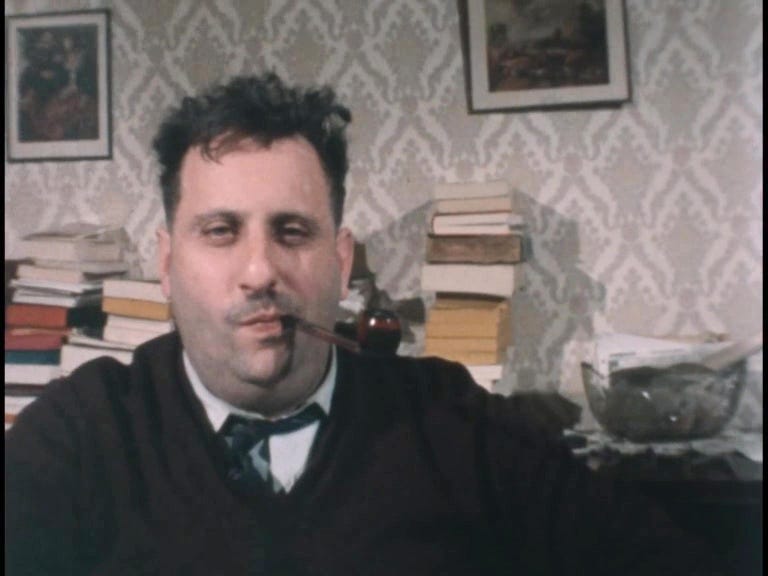
What is the documentary about? It orbits an amateur theatre group. The group is composed of “former mental patients brought together after their hospitalisation and some of their therapists.”
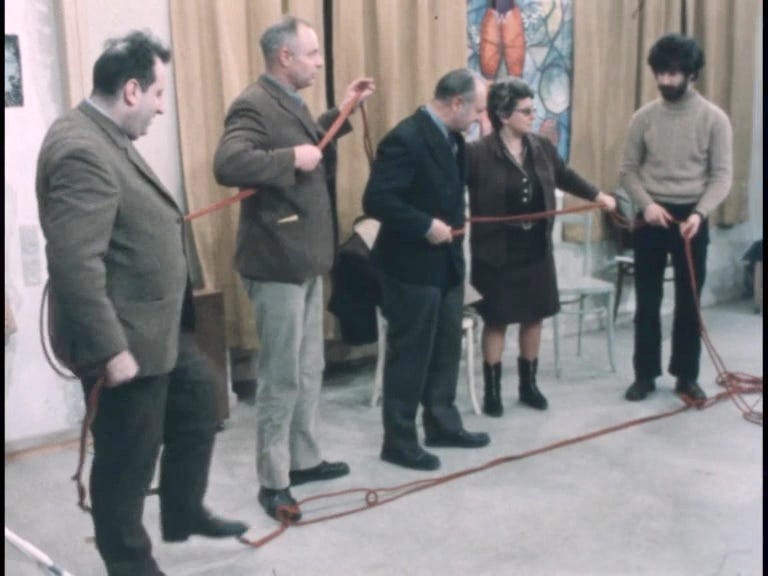
They have devised a play to perform. A play about a group of lost mountaineers. The lost mountaineers must decide whether to escape the purgatorial mountain inn they’ve found and attempt to return to the world below. Where war may or may not have broken out in their absence.
The subjects maintain each of their defining wobbles evenly for the duration of the edit. There are no revelations, no catharsis. No substantial conflict outside of:
the perpetual inner conflict of the human condition, and
the sustained web of conflict of social interaction and cooperation.
And certainly no resolution.
They just be. The concert pitch - their establishing note - is the thing.
That opening sequence tune-up drone soon begins to grate on the movie’s audience. A psychoacoustic effect. Or perhaps it is the unease of being held in an extended moment that causes the sound to grate. The uncanniness of unsatisfied patience.
But no one is more impatient, during the opening sequence, than the subjects themselves. Talking about their real lives when they long for the meta-being of the rehearsal room. The droning chord and montage structure of the opening sequence emphasise the soupiness of their lives. No continuity editing, no cause and effect, just the soup of existence.
“I wanted to express the idea of breaking free from suffering,” says Cécile, describing the development of the play’s plot. “…To not stagnate in this inn or in this club. To be able to leave it, snap out of it and fly away.”

But the form of the movie will not permit the actors exception from the stagnancy of routine. Most of a play is not a show going on but a rehearsal percolating in evenly lit rooms. For most of Don’t Stagnate’s 86 minutes, the subjects are trapped in ambient leisure time. Preserved in the amber of Tuesday night hobby club lighting. The film’s audience, too.
There is no indication how many weeks or months of rehearsal take place. Or whether each sequence was filmed before or after the next.
Rehearsing the climbing of the mountain, the subjects walk in circles around the room. The characters are tied to each other by rope. And the actors are tied by shared transport arrangements. Lehman likes to keep the camera still, even when the main action drifts out of frame. Emphasising currents that might otherwise be missed: Romain’s tapping foot, Robert’s nervous humour, Maurice’s vanity.


In the last half-hour, Lehman begins to layer in shots of the black box performance proper. The event of the show’s performance offers false hope of catharsis or resolution. But Lehman continues to cross-cut performance footage with scenes from the rehearsal.
Scenes on the darkened stage echo or prefigure the dialogue that continues in the amber rehearsal room. On stage, the subjects continue to grin out of character. The sophisticated young directors continue to whisper line prompts.
Actors, characters, and home audience alike remain in purgatory.
Between the prologue and the epilogue, neither the subjects nor the viewers have seen the sky, daylight, a horizon. And there will be no aftermath. When the performance finishes, Charles struggles to even leave the stage. Wandering around, looking for something he’s dropped, oblivious to the humming audience.
Please share your thoughts, queries, and exercises from this week’s lesson in the comments.
Time’s precipice
And so, echoing Daumal, Lehman leaves his Austin Allegro-era amateurs halfway up the hill, forever.
But despite the foreshortened arrival of the end of term, I trust that you - dear student - have made it to the peak of understanding or safely back to base camp. Wherever you want to be, really.
Let me know in the comments.
Until whenever,
~Graeme Cole.
(Principal)
P.S. A final pertinent song recommendation before fading:
🦋 Bluesky | ⏰ TikTok | 📸 Instagram | 😐 Facebook | 🎞️ Letterboxd | 🌐 unfound.video